
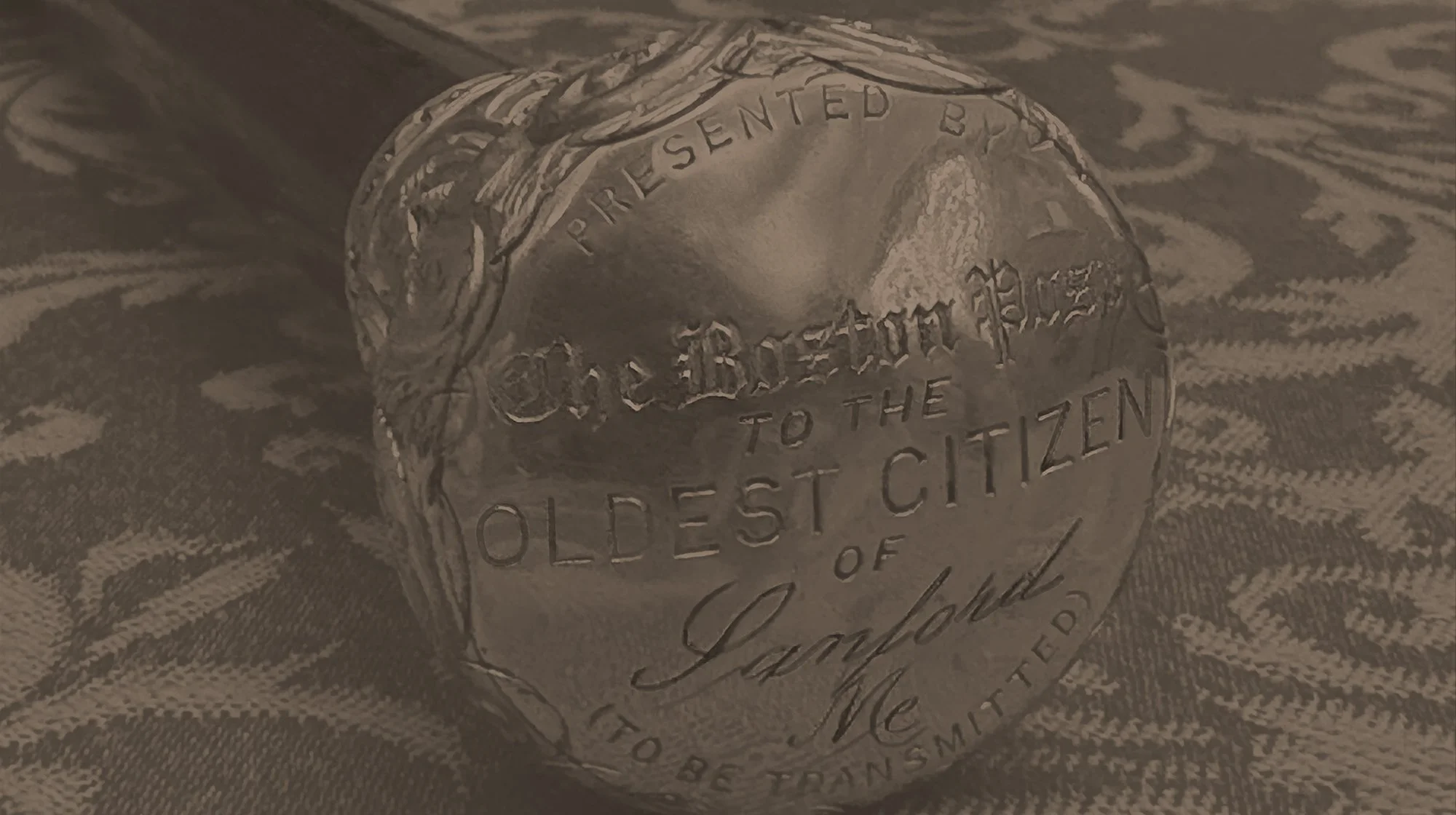
The Boston Post Cane of Sanford
History of the Boston Post Cane
Written by Paul G. Auger
In the late summer of 1909, Edwin A. Grozier, publisher of the Boston Post newspaper, launched one of the most enduring publicity campaigns in New England history. Grozier contracted J. F. Fradley & Co. of New York to craft approximately 700 fine walking sticks made from African Gaboon ebony, topped with 14-karat rolled-gold heads intricately hand-engraved with the inscription: “Presented by the Boston Post to the Oldest Citizen of [Town] — To Be Transmitted.”
These canes were sent to the Board of Selectmen (or city councils) in hundreds of towns across Maine, Massachusetts, New Hampshire, and Rhode Island. The agreement was simple: the local leadership would present the cane to the town's oldest living resident to hold for life. Upon that person's passing, the cane was returned to the town and passed down to the next oldest citizen.
Originally restricted exclusively to men, the rules were amended in 1930 to allow women to receive the honor. Though the Boston Post ceased publication in 1956, hundreds of New England communities kept the tradition alive.
Sanford embraced the tradition from the start, awarding its cane to a lineage of long-lived residents whose lives stretched back to the early 19th century.
Sanford’s first recipient was Lyman Hooper in 1909. Hooper was born in 1818; when Sanford was still a Massachusetts town.
Sanford Recipients
1909: Lyman Hooper
Born during the lifetimes of John Adams and Thomas Jefferson in 1816, Hooper became Sanford’s inaugural Boston Post Cane holder in 1909. He held the honor until his death in May 1910 at age 93.
1910: Nathaniel Gile
Awarded the cane later in 1910, Gile held the honor for only a few months before passing away in December at age 87.
1911 ??: Charles H. Frost
Reaching 96 years of age, Frost carried the tradition through the post-World War I era, passing away in 1926.
1930: Charles H. Dow
Awarded the cane prior to November 1930, Dow appears to have held it until his death at 92 in 1933.
1933: Charles B. Hamlin
Awarded on June 6, 1933, Hamlin was the father of Sanford’s Superintendent of Schools, living to be 100 years, 6 months, and 2 days old.
????: James M. Phillips
Phillips was a descendant of Major William Phillips, the namesake for Phillipstown, Sanford’s original name. Phillips held the cane until just after his 93rd birthday in 1938.
1946–1951: Frederick Maud
Awarded the cane shortly after his 100th birthday in December 1946, Maud went on to reach 104 years, 11 months, and 5 days, making him one of the longest-lived holders in Sanford's history.
The Missing Years
Like many municipal artifacts across New England, the original Boston Post Canes became vulnerable over time—some were misplaced, damaged, or kept as heirlooms by grieving families. Sanford’s cane was lost sometime after 1948. It was anonymously returned to the town (now a city) around 2001.
A Tradition Resumes
After researching more than 40 Boston Post Cane municipal policies, the Sanford-Springvale Historical Society drafted a model policy to resume Sanford’s tradition. Sanford’s City Council approved the policy October 6, 2026. To help preserve the original cane, the society purchased a replica cane and had it engraved in Boston. The city will keep the original cane at the Sanford-Springvale Historical Museum and will allow recipients to keep the replica during their tenure.
Nominations
A 30-day nomination period will soon open to carry on this unique New England tradition. Eligible residents will need to have lived in Sanford for a cumulative 20-years and they or their nominators will need to provide proof of residency and birth. The next recipient is expected this year.
Photo Caption: James M. Phillips (1845–1939) holding the Boston Post Cane at his home at Sand Pond. (Photo by Armand “Jack” Sevigny / Sevigny Collection, Print 0643, Sanford-Springvale Historical Society)